Friday, August 9, 2019

Research for Magazine - Website

Research for Magazine - Website

Genre = Music & Fashion

Other Fashion Magazines (including music) to base research upon:
- W Magazine
- Dazed & Confused Magazine
- Wonderland Magazine
- i-D Vice Magazine

I tried to choose 4 very diverse magazines, aimed at different target audiences (all within my 16-24 age range) in order to get a wide range of connotations and similarities between a wide range of magazines, as well as see how different magazines can target different audiences in unique ways to others.
 W Website
What I first notice is the text which is present directly in centre screen. This immediately focus' attention onto the main headlines. This text is supported by the photo below it, and the photos on either side are supported by a headline below them, therefore only 1 photo is used per article on the home page. The logo of W is centre screen also but in the banner at the top. To the left of this is W Magazine's social media links, and to the right is a subscribe button with a picture of the latest
magazine to support it. Just below this immediate banner is a
search function where you can either directly search for an
article or choose a category you would want to view. The black
white colour scheme is also kept which links to its brand identity
of the physical magazine copies.
 Dazed & Confused Website
As soon as you click on the page, a giant banner at the top which features the name of the magazine is present. This is white on a yellow background, however has a photograph merged into the background. At the bottom right of this banner are two sponsored advertisements. Below this, at the left of screen, is a large close up shot of a woman's face. This has a heading just below the photo and is therefore the main headline. To the right of screen is a column of different news articles, with each
article being supported by 1 image. These are all labeled clearly
with what category they cover (fashion, music, politics).
 Wonderland Magazine
Unlike the other two websites, the immediate view of this website is only one large photo with the headline "Lili Reinhart She's a Hustler!". This doesn't have as much of a beginner friendly vibe to it in comparison to the other magazines where you can search or look for what you want to find (even though there is a very small search icon in the top bar at the right of screen). In the top banner is the name of the magazine in centre screen, and a drop down at the left hand of the screen where when you hover over it opens up different categories of news. When you scroll down there is a list of most read articles at the moment in time, with the different categories of news being below it. 

 i-D Website
Immediately a male and female representation and target is created with a split image taking up the entirety of the screen. Both of the pictures belong to the same article with the headline of it being centre screen. However, just above this is the logo of the magazine, directly in centre screen, the logo is also in the top banner. This featuring twice goes against the conventions present in the other websites where only one logo is present on the screen at one time. Once again at the top left, there features a small button which creates a drop down of all different genres on the website, and features a search button incase you want to look for a specific article. If you scroll down past the original headline, there is lots of articles which are new to i-D under the subheading "today on i-D". Above the headlines it shows the genres of news it fits into. Also in the banner, it now features the social media links at the top right.

Wednesday, August 7, 2019

Research for Magazine - Contents Page

Research for Magazine - Contents Page 

Genre = Music & Fashion

Other Fashion Magazines (including music) to base research upon:
- W Magazine
- Dazed & Confused Magazine
- Wonderland Magazine
- i-D Vice Magazine

I tried to choose 4 very diverse magazines, aimed at different target audiences (all within my 16-24 age range) in order to get a wide range of connotations and similarities between a wide range of magazines, as well as see how different magazines can target different audiences in unique ways to others.


W Magazine Example
The first thing which grabs the readers attention is the giant photograph present at the side of the contents. Unlike other magazines, there is only 1 photograph on the contents instead of being a wide variety, and this leaves the text not much flexibility within columns to fit. This means that all the text is in one single column at the left hand side, with different page numbers being under the subheadings "WHAT",  "WHERE", "WHY", "WHEN", and "DEPARTMENTS". This easily distinguishes the pages to allow the reader to quickly find something that they would want to see, e.g. a certain celebrity. Also at the top of the page, there is the logo of the magazine as well as the date published. The only colour of font used is black.


Image result for dazed magazine contents

Dazed & Confused Magazine Example
Once again only a single photograph is used in this contents, however this one isn't as big as the W one. The photograph sits below the Contents signal but above the actual contents information, making it stay centre of the page. The contents is split into 2 different columns, "Features" and "Regulars", which are both self explanatory to what they contain. Features contain new things for the magazine whereas Regulars contain common occurrences between the different editions. At the top right hand corner of the page, there is a copy of the front cover of a different magazine edition, henceforth advertising further. The main colour of font used is black.


Image result for i-d magazine contentsi-D Magazine Example 
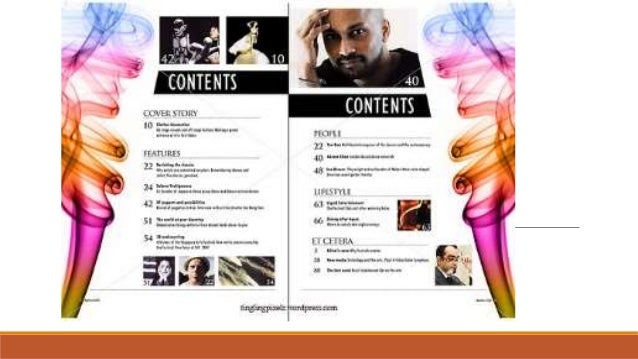
This is a double page spread contents unlike the other two which are single page. To start off, it is filled with lots of varying photographs of different things which relate to the magazine and what it contains. This is more conventional of most magazines due to the easier understanding of the reader. These are mostly small boxes which are scattered around among the text, however there are some bigger ones at the top of the page which heavily divert attention towards them. At either side of the double page, there is a bright/colourful swirl of varying colours, this really brightens up the page and makes it look less serious due to the black and white general theme. In terms of dividing, the contents splits up the interior of the magazine into 5 sections, cover story, features, people, lifestyle, and etcetera. This is similar to W Magazine and it allows the reader to easily find what they want to look for.

Saturday, August 3, 2019

Research for Magazine - Front Cover


Research for Magazine - Front Cover 

Genre = Music & Fashion

Other Fashion Magazines (including music) to base research upon:
- W Magazine
- Dazed & Confused Magazine
- Wonderland Magazine
- i-D Vice Magazine

I tried to choose 4 very diverse magazines, aimed at different target audiences (all within my 16-24 age range) in order to get a wide range of connotations and similarities between a wide range of magazines, as well as see how different magazines can target different audiences in unique ways to others.

Related imageW Magazine Example
In this front cover, a popular music icon (Beyonce) is used as the model. She is making eye contact with the camera while not giving much facial emotion in order to create an idea of power for her. This is a medium shot of her with centre focus, where the audience cannot see below her waist. For the background, a deep and regal red colour is used where it still shows depth to the image by not being a flat colour.

An all capitals and thin font is used in all the text, with only the size of the text and boldness changing - even with the name of the magazine. This is done in a white colour to go stand out against the background, this technique is often done in tabloid newspapers to make writing stand out. The main texts which stand out are "Beyonce Dressed To Kill", "Music & Style" and "Listen UP! Fashion's New Beat". All 3 of these include both music and fashion connotations.


Dazed & Confused Magazine Example
In this front cover, there are 2 photographs of a model which are merged into one split photo. One of the photos is a very extreme goth-like character whereas the other is a bland looking and normal boy. One way you could interpret this would be that there is always rebellion within all youth, as the boy on the right wants to become like the one on the left. The other way you can interpret this is that within rebellious youth, they still hold the want of wanting to live a normal life. Both of these interpretations target different audiences of youth at the same time. Behind the boy on the left is a plain black background, and behind the one on the right is white. This use of black vs white both makes the magazine give a very extreme polar opposite, as well as stand out to an audience due to its originality of non-generalised characteristics of a colourful cover.

The fonts are all in capitals and keeps the same black vs white colouring that the pictures have. The only text which stands out is "Not Everything is Black and White" which once again expresses a very subtle and vague meaning.

Image result for wonderland magazine covers musicWonderland Magazine Example
I chose both of these front covers as examples as they both contain the same model but both feature different types of shots to advertise the magazine. In the top cover, Shawn Mendes (famous singer - songwriter) is slightly left of frame in an extreme close up shot. He is looking slightly to the left of camera too, not making direct eye contact with the reader. The colours in this cover are very light focused, with a white shirt and a white background being present. This overall presents him as a fun character.

Image result for wonderland magazine covers musicIn the second cover, a further away medium shot is taken of him being to the right of screen. In this he has his head slightly tilted upwards to give a smug representation, and is making eye contact with the camera. Also the general colour of this cover is a lot darker, with the background being a dark grey beige and him wearing denim with dark jeans.

In both covers, a very minimalistic design is taken upon, where there is next to no external text apart from the name of the magazine and the name of the model. These are both again in a white colour, with the name of the model being in all capitals.


Related image
i-D Vice Magazine Example
In this cover, once again a famous music icon (Rihanna) is used to model. The photograph is a close up where only her chest and head is in camera view, and where she is posed in centre screen. The model is making eye contact with the camera with a very displeased/aggressive facial expression, this creates the representation of fear for the reader. Her hair is styled in a way to go against general fashion conventions of long and non-tied up hair, however this adds to her facial expression again, with one strand of it covering an eye to almost break the eye contact.

The text used is very minimal again with the only noticeable text being "play loud". This is once again in a white font, however unlike the other magazines is in complete lower case with no punctuation.

Friday, July 26, 2019

Original Plan for Covers

 These are the original genres of magazines I planned before narrowing down my choice. In this I included potential articles, gender focus and potential names.

I took my favorite idea and expanded on my ideas, giving me a clear basis upon which to expand upon.

Monday, July 15, 2019

Researching the Target Audience - survey

Researching the Target Audience


For my survey, I had 28 usable responses with 15 being male and 13 being female. However, 70% of all of my answers were ranged between the 16-18 year old age group. On my survey, I let each of these pick multiple favourite genres of magazines to read.
The most popular genres which I found for males were: gaming, technology, music, film, and sports.
The most popular genres I found for females were: music, fashion, and gossip.

A surprising result I found was the interest of food and drink within both genders, meaning that this would be a good thing to include in my magazine to some extent.

The next question I asked was how much they read magazines, with about 85% of people answering "Never" or "Rarely". This implies that there isn't a big demand for magazines in my target audience. This could be due to the internet being very prevalent within this generation. This means that including plugs for social media could be beneficial to my newspaper.

Another question I asked in my survey was which part were they more likely to read/focus to. I expected main articles to be the most popular result, however the interest in puzzles was also noticeable. This implies that the most important thing for a good magazine is the main article's initial appeal to the reader.
I also found that noone said that they looked at small articles, advertising, and surveys. This implies that these have no appeal to an audience and therefore including them on the front cover would not be favorable to my target audience.


Research - Hearst Magazines UK

Research Hearst Magazines UK

On the Hearst Magazine website, many of the magazines shown are more targeted to an older demographic. This is because of the idea of wealth present in many magazines in the genres of fashion, travel and decoration. However there is a relation to younger cultures being shown with the addition of food magazines such as Food Network.

The list of their magazines are:

Fashion:
- Elle
- Bazar
- Esqice
- Town & Country

Lifestyle:
- Cosmopolitan
- Asda Good Living
- Best
- Good Housekeeping
- Prima
- Red

Health:
- Liza Earle Wellbeing
- Men's Health
- Women's Health
- Netdoctor
- Running

TV/Film:
- Digital Spy
- Inside Soap

Interior Design:
- Elle Decoration
- House Beautiful

Other:
- Financially Fabulous
- JOURNEY
- QP
- Real People
- Country Living

Monday, July 1, 2019

Research - Bauer Website

Research -  Bauer Website

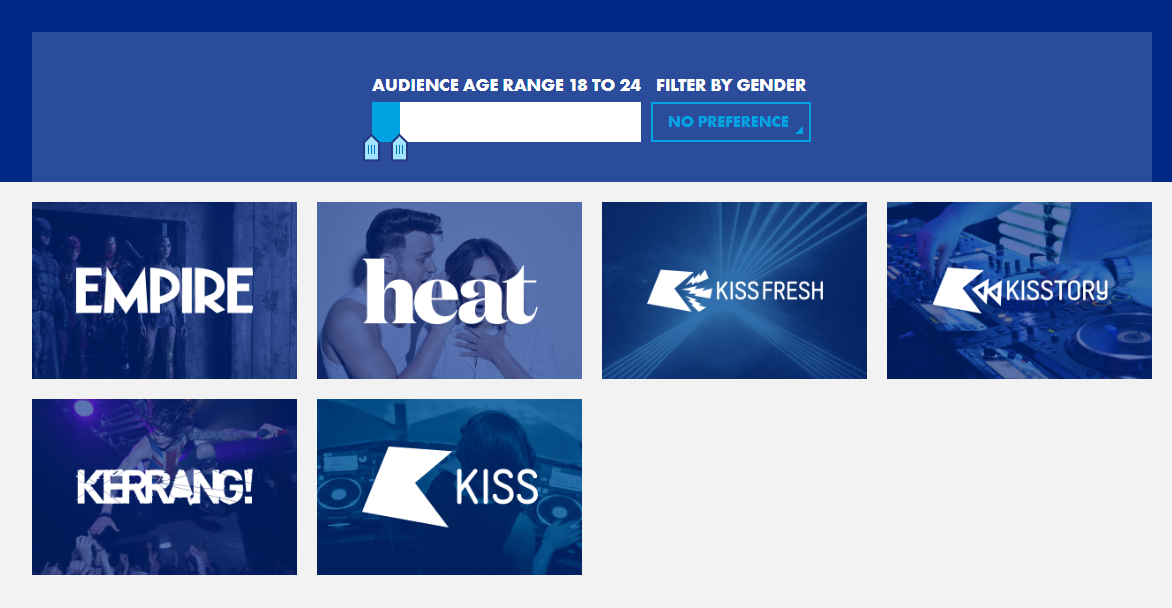
On the Bauer website, there are only 6 companies which are appealed to an age range between 18-24, within these there are 4 different music companies, a gossip outlet and a film outlet. This shows that there is a big demand for modern music within my target age group, however due to these 4 big influencers there is not much of a gap in the market.


In these magazines, most of them include sports such as fishing and golf, as well as many surrounding different cars. Although the car genre can apply to all age groups, most o the magazines are most likely targeted to appeal to an older age group. This is supported by only 2 magazines here linking to the "audience age range finder" between 18-24. This implies that there isn't many people around my target age group that purchase magazines. Linking to Bauer's previous research on millennial's, 11% of millennial's are influencers, and these spend the most time online. Due to them being influencers, trends that are set are mostly started by them, which are also seen from things they see online. This implies that there is a greater focus on online advertising towards this target audience rather than on magazines. This would link to websites being an influential set on trends instead of creating different magazines to appeal to them.

The Millennial Chapter is the study done to find these results. This is where qualitative and quantitative research took place in order to split the genre of millennial's into 5 distinct segments, influencers, adopters, apprentices, entertained, and contented. This information gives a lot of information to agencies, advertisers and Bauer to let them learn how to both approach and sell to this target audience.

Monday, June 24, 2019

The 'Entertainment' Genre

The 'Entertainment' Genre

Sub-Genres

- Film & Cinema
- Technology
- Music
- Gaming
- Home Entertainment
- TV Guides
- Hobbies & Leisure
- Sports
- Fashion & Beauty
- Food & Drink
- Gossip / Celebrity
- Art
- Education

Age Groups:

16-18:

Gaming, Music, Sports, Fashion & Beauty, Technology

18-21:

Film & Cinema, Sports, Fashion & Beauty, Gossip / Celebrity, Music, Technology, Gaming

21-25:

Film & Cinema, Technology, Home Entertainment, Hobbies & Leisure, Food & Drink, Gossip / Celebrity, Education

My Preferences

Music, Sports, Food & Drink, Education (Science aspect of it)

Thursday, February 7, 2019

The Guardian

The Guardian

File:The Guardian.svg Guardian is a broadsheet newspaper, owned by Jonathon Crook via Scott Trust Limited (this trust also owns the Guardian Media Group). This trust has resisted buyout of the newspaper by larger media owners in the past. The editor of The Guardian is Katharine Viner, who has been editor in chief since June 2015. Before then she started as a writer of The Guardian in 1997 and promoted to deputy editor in 2008. 

It is a very left wing biased newspaper and is so backed by the Labour Party. Due to being less conservative than The Daily Telegraph and The Times, its main London competitors, it once gained the name "Britain's non-conformist conscience".

It is known as one of Britain's leading daily newspapers with an average of 162,000 copies being printed daily. This is mostly by their intended readership of an educated, middle class, 18+ and left leading audience.

Who is the Guardian Regulated by?

Image result for ipsoIt is regulated by Ipso (International Press Standards Organisation) who hold newspapers responsible for any controversial actions, protect individual right, uphold high standards of journalism and help maintain the freedom of the press.
Specifically to do this, they:
- make sure newspapers follow the Editors' Code- investigate complaints to disregard of the Editors' Code, and if a problem is found makes the newspaper change it. They can also fine the newspaper up to £1 million.
- provide guidance, training and advice for editors and journalists
- provide a hotline for journalists who are being mistreated by their company
- work with charities to provide for better press standards

History

Image result for charles prestwich scottThe Guardian was founded in Manchester 1821, known as the Manchester Guardian. For the first 34 years, it was a weekly based newspaper, however in 1855 this had to change due to the government lifting the Stamp Tax. It's name was changed to The Guardian in 1959, dropping the "Manchester" to be able to reflect the newspapers standing as a  daily with an international reputation.

It has been praised for its investigative and thorough journalism, its literary and artistic coverage and criticism, and its foreign correspondence since its release. This editorial approach is due to a 57 year tuner of Charles Prestwich Scott, which started in 1871 when the paper covered both Prussian and French sides in the Franco-German War. He once quoted "Comment is free. Facts are sacred... The voice of opponents no less than of friends has a right to be heard."


Wednesday, January 30, 2019

The Daily Mail

The Daily Mail


The Daily Mail is a tabloid newspaper owned by the Daily Mail and the General Trust. It has become the second most
selling newspaper in Britain today with a circulation of 1,222,611 and  has won Press of The Year numerous times.

Early History of the Daily Mail

 It has been a giant success since it was released on the 4th May 1896 where it w
as expected to release 100,000 copies but instead 397,000 were printed instead. This was also increased once again 3 years later to 500,000. One of the reasons for its success was because it cost a halfpenny, whereas other dailies in London cost a penny. As well as this, in its first year it broke new journalistic ground by having an emphasis on speed. This was completed using new technology (such as the telegraph) which allowed them to release stories quicker than their competitors.

Within a few years of release, its readers were over 1 million, making it the largest newspaper in the world. Because of this success, in 1900 it allowed the Daily Mail to start printing simultaneously in Manchester as well as London. At this time, a big emphasis was on aviation and new achievements in this craft. Because of this, in 1906, the Daily Mail started offering prices for achievements in this craft to pilots. The first one given was £10,000 for the First flight from London to Manchester. These rewards ended in 1930.

The Daily Mail Facts

A survey in 2014 found that the average age of its reader was 58 and that it had the lowest demographic for 15 to 44 year olds among all the major British dailies.

It has a majority female readership with woman making up 52-55% of its readers.

Its website has more than 100 million unique visitors per month

Final Website

This is the link to my website -  https://arictompkinson.wixsite.com/modomodo My working link page is "ENTERTAINMENT" on the top...